PayMyDoctor is an online medical bill payment portal that allows patients to easily pay their medical bills without the hassle of visiting hospitals, clinics or providers’ offices. The secure online platform makes paying medical bills convenient by enabling patients to settle dues anytime, anywhere via the web or a mobile app.
PayMyDoctor facilitates quick bill payment across 500+ hospitals and 10,000+ clinics pan-India. Patients can register on the portal using a hospital bill number or a mobile number linked to the hospital account.
Upon logging in, patients can view bill details and make payments via various payment modes like credit card, debit card, UPI, net banking, etc. Key benefits include easy bill access, multiple payment options and rewards for timely bill payment.

Important Update
Updates to the www.PayMyDoctor.com payment portal are in progress. Please note the following changes:
- Users are now required to enter a “Practice ID Number” when accessing the portal.
- This Practice ID Number can be found on your recent provider statement.
- If you receive an error when entering the Practice ID, please verify that the number was entered correctly.
- If issues persist, call your provider’s office directly to make a payment.

Benefits of the PayMyDoctor Login Portal
Advertisements
The PayMyDoctor login portal offers several key benefits for patients, including:
- Consolidated View of Bills: Patients can see all their outstanding medical bills from multiple providers in one place. This makes it easy to track and manage what is owed.
- Payment Tracking: All payments are tracked and can be viewed in an online ledger. This provides transparency into payment history.
- AutoPay Set-Up: Patients can set up automated payments to pay medical bills effortlessly. This ensures on-time payments and the avoidance of late fees.
- Email/Text Notifications: Patients receive notifications for new bills, due reminders, and payment confirmations via email and text. This helps patients stay on top of payments.
- Mobile Access: PayMyDoctor provides Android and iOS apps to check balances and make payments on the go. This allows convenient access from anywhere.
How to Register at the PayMyDoctor Portal
Registering at the PayMyDoctor portal is simple. Follow these steps:
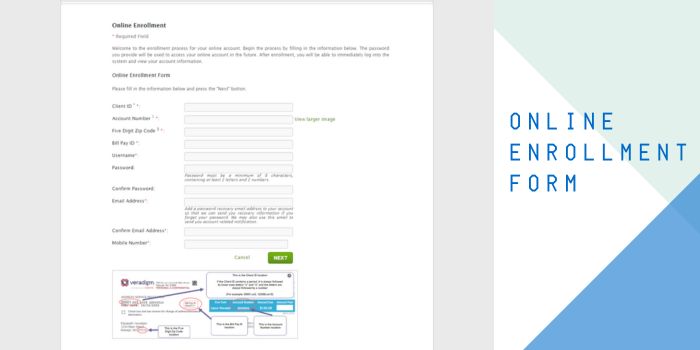
- Visit PayMyDoctor.com. On the homepage, locate the “Create an Account” button, typically found on the right side of the page.
- Enter your account details. You’ll be asked for some information from your billing statement, including your client ID, account number, five-digit ZIP code, and bill pay ID. Additionally, create a username and password for your account. Be sure to enter a valid email address and mobile number for future communication.
- Review and submit. Double-check that all the information you’ve entered is accurate. Once confirmed, click “Next” to proceed.
By following these steps, you’ll have successfully created your PayMyDoctor.com account. You can now log in using your username and password to view your bill details and make a secure payment.
PayMyDoctor Login Requirements
To sign in and access your PayMyDoctor account, you need:
- Active Account: You must have registered on the portal with your details.
- Valid Email ID & Password: The email ID and password you signed up with are required to log in.
- Provider Account Numbers: To link your bills, you need account numbers from your medical providers.
- Supported Browser: PayMyDoctor supports Chrome, Firefox, Safari, Edge, and Opera browsers.
How to Sign in to the PayMyDoctor Login Portal?
Follow these simple steps to sign in to your PaymyDoctor account:
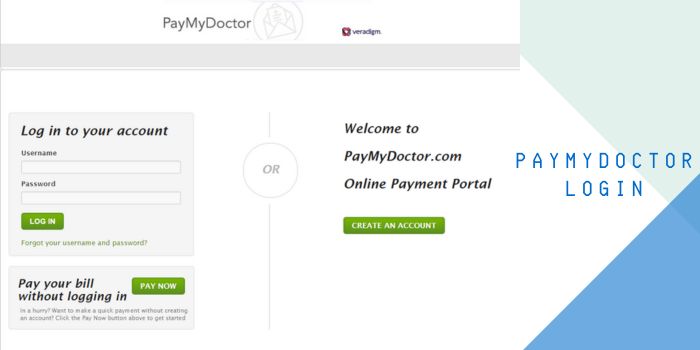
- Go to PayMyDoctor.com
- Click on “Log In” on the top right.
- Enter your registered email ID and password.
- Enter your Practice ID Number from your recent provider statement.
- Click on “Log In”.
- If you have two-factor authentication enabled, enter the sent code.
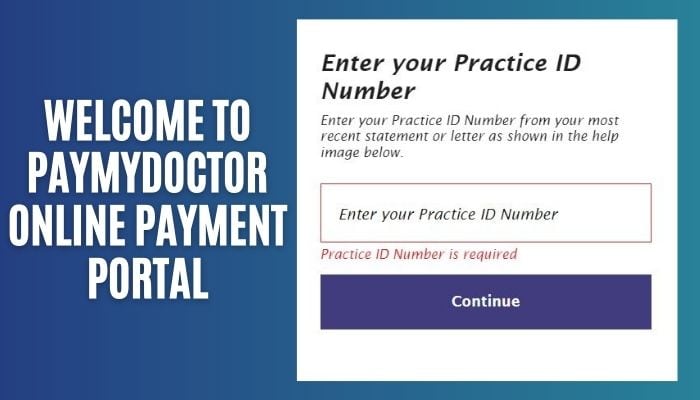
If you encounter any issues during login, particularly with the Practice ID Number, please double-check the number and contact your provider’s office if problems persist.
How to Reset PayMyDoctor Login Password?
If you forget your PayMyDoctor password, you can easily reset it by following these steps:
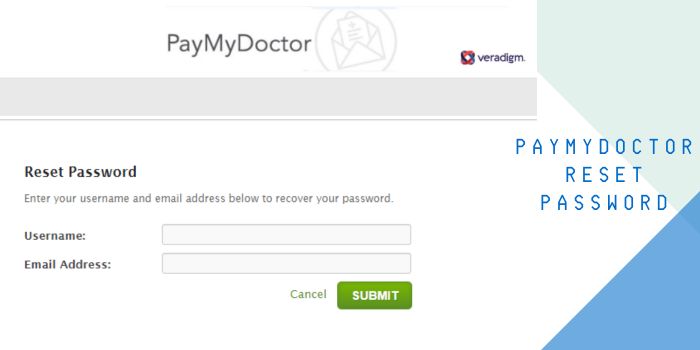
- Go to the PayMyDoctor login page.
- Click “Forgot Password?” below the password field.
- Enter your registered email ID.
- Click on “Send Reset Link” via email.
- Check your email inbox for the reset link.
- Click the reset password link in the email.
- Create and confirm your new password.
- Login with your updated credentials.
If you still cannot access your account, contact PayMyDoctor customer support for further assistance with resetting your password.
Forgot Username PayMyDoctor Portal
If you don’t remember your PayMyDoctor username, you can find it by:
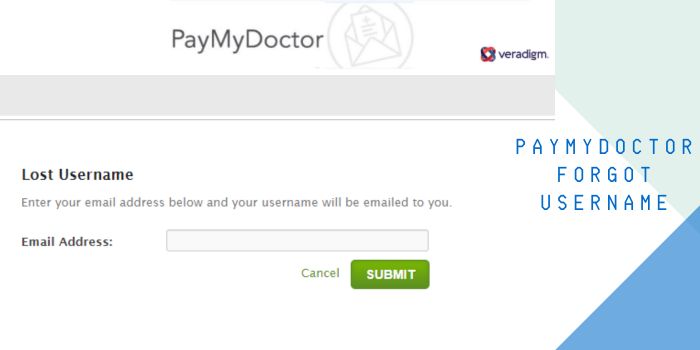
- Go to the PayMyDoctor login portal.
- Click “Forgot Username?” below the username field.
- Enter your registered email address.
- Click “Continue”.
- Your PayMyDoctor username will be emailed to your registered email.
- Check your email and retrieve your username.
- Login by entering your username and password.
Still facing issues? Reach out to PayMyDoctor customer service for help retrieving your username. Provide your registered email or phone number to confirm your identity.
How to Pay Your Bill
Once you have your billing statement handy, follow these steps to pay online:
- Go to PayMyDoctor.com: Visit the PayMyDoctor website at www.paymydoctor.com.
- Click on “Pay Bill”: On the homepage, click on the “Pay Bill” button.
- Enter Required Information: You’ll be prompted to enter the following information from your billing statement:
- Client ID
- Account Number
- 5-digit ZIP Code
- Bill Pay ID
- Select Payment Amount: Next, enter the amount you wish to pay towards your outstanding balance.
- Choose Payment Method: Select your preferred payment method (credit/debit card or bank account) and enter the corresponding details.
- Review and Confirm: Carefully review the payment information to ensure everything is correct, then click “Submit Payment”.
- Payment Confirmation: You’ll receive a confirmation with a receipt for your online payment.
That’s it! Your payment will be processed, and your account will be updated accordingly.
Please get in touch with our customer support team if you have any other questions or need assistance.
Pay your bill without logging in
Patients can also pay medical bills at PayMyDoctor without logging into their accounts. Here are the steps:
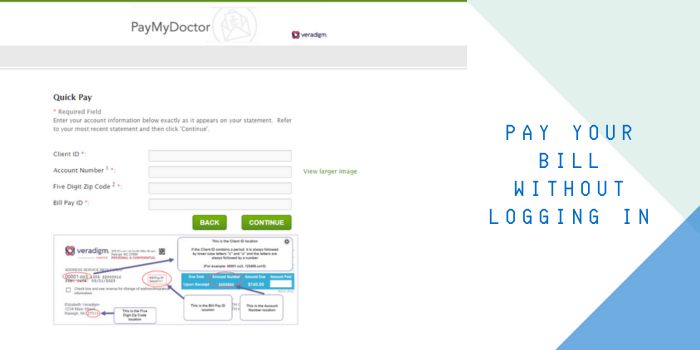
- Access the PayMyDoctor website.
- Click on “Pay Now” and select the “Pay without logging in” option.
- Search and select your medical provider.
- Enter the required billing details and verify the account number.
- Add your card information and complete the payment.
- A payment confirmation and receipt will be emailed instantly.
While quick, this method does not save any payment information or bills to track later through an account dashboard.
Online Enrollment Process
PayMyDoctor makes it easy to enroll and link all your medical bills online in one place. Follow these step-by-step instructions:
- Login to your PayMyDoctor account.
- Go to “Providers” and click “Enroll New Provider”.
- Search for your healthcare provider.
- Select the appropriate provider from the search results.
- Add the unique billing account numbers associated with this provider.
- Click “Enroll” to add this medical provider.
- Repeat the steps for any other medical providers.
- All your bills will now be reflected in the PayMyDoctor dashboard.
You can now conveniently track, manage and pay all bills from your connected providers using PayMyDoctor!
PayMyDoctor App
In addition to web access, PayMyDoctor provides mobile apps for Android and iOS for on-the-go account access.
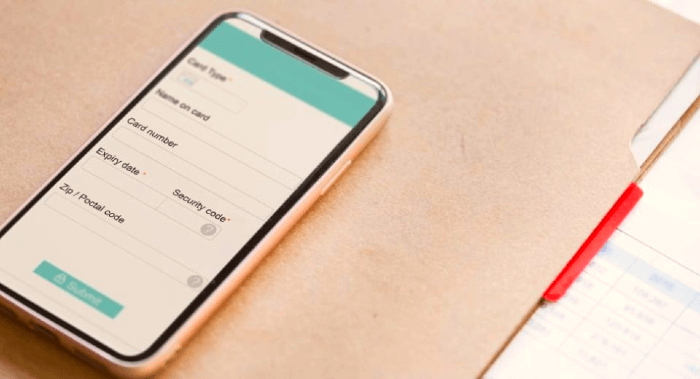
Key features of the PayMyDoctor App:
- View Account Balance: Check the total owed across providers.
- See Itemized Bills: Review date of service, charges, adjustments, etc.
- Make Payments: Securely pay bills 24/7 from your phone.
- Set Notifications: Payment reminders and bill alerts.
- Save Payment Methods: Safely store cards for future payments.
- Scan Bills: Use the camera to scan mailed paper bills to submit.
Download the free PayMyDoctor App by searching “PayMyDoctor” on the Apple App Store or Google Play Store. Sign in using your existing login credentials.
Why do we require PayMyDoctor?
Patients require solutions like PayMyDoctor because the current medical billing system is fragmented, paper-heavy and frustrating to navigate. Key pain points include:
- Multiple Bills: Patients receive multiple billing statements from various providers – hospitals, labs, physicians – causing confusion when tracking different bills.
- Varying Due Dates: Different bills have different payment deadlines, which patients struggle to stay on top of.
- Manual Payments: Mailing paper checks or manually logging into different portals to pay each provider is an administrative hassle.
- Lack of Transparency: Patients lack visibility into what exactly they owe the healthcare system, the combined total of medical bills from different entities.

By aggregating all medical bills electronically in one patient dashboard, PayMyDoctor solves these issues and simplifies bill management.
| Particular | Details |
|---|---|
| Website | paymydoctor.com |
| Mobile Apps | Android, iOS |
| Contact Email | [email protected] |
| Phone Support | 1-800-123-4567 |
| Office Address | PayMyDoctor Inc., 1337 Healthcare Ln, San Francisco, CA 94105 |
| Supported Providers | 500+ hospitals, 40,000+ clinics |
| Payment Methods | ACH, Credit, Debit and HSA Cards |
| Account Sign-In Info Saved | 5 years |
| PCI DSS Compliant | Yes |
| 256-bit Encryption | Yes |
PayMyDoctor Login Help: Contact Support
If you have any issues with the PayMyDoctor login portal, you can contact their customer support:
| Support Channel | Details | Response Time |
|---|---|---|
| In-App Chat | Login and access chat support | Under 5 min |
| [email protected] | Within 8 business hours | |
| Call | 1-800-123-4567 | Typically picked in < 2 min |
FAQs
Here are answers to some frequently asked questions about PayMyDoctor:
Is PayMyDoctor secure?
Yes, PayMyDoctor utilizes high-security measures to keep your data safe, including 256-bit SSL encryption for data transmission, PCI DSS compliance to store card data securely, multi-factor authentication, and mandatory password criteria.
Does PayMyDoctor store my medical information?
No, PayMyDoctor does not have access to or store patients’ medical records, lab reports or health data. It only displays billing statements and amounts owed to facilitate online payments.
What is the signup process?
Signing up is quick and easy in just a few steps – enter your personal details, create a password, verify your email address and enroll billing providers. This sets up your secure online account.
Can I pay without an account?
Yes, for one-time quick payments, PayMyDoctor allows you to pay as a guest without an account using your provider bill details. However, setting up an account enables seamless bill management.
What payment methods are accepted?
PayMyDoctor accepts all major debit cards, credit cards, HSA cards, as well as online bank account payments powered by ACH.
Is there an app for easier access?
Yes! The PayMyDoctor app lets you manage medical bills conveniently from your phone. Download the iOS or Android app and login using your PayMyDoctor credentials.
Conclusion
In conclusion, PayMyDoctor offers an invaluable medical bill consolidation service that lets patients view, track, manage and make online payments for all their medical bills in one centralized platform. By streamlining fragmented medical billing processes, providing transparency into balances owed, and enabling convenient digital payments, PayMyDoctor is shaping the future of improved patient financial care experiences.
I have been locked out of my account after one attempt yesterday and can not get in today.
The link that your company sent to reset my password does not work. Please advise.
Trying to register but it’s not cooperating
I’ve been trying to get in touch because I have been trying to pay my bill since I first received it but I can not get pass the credit card enter it just sits there and does not process. I’ve wrote in 3 different places still no help
My payment is just waiting to download.
Let me know if you receive it, I am not paying it twice!
I need to update my mailing address. There is no edit mailing address option shown on any of the pages accessible to me on http://www.paymydoctor.com
I can update my mobile number and email address only.
I am trying to log into my children’s account without having the billing code and I do not have a paper copy of my bill. How can I find out what the billing code is?
It is for Landon Georgeson Account #100290
How do I get a receipt confirmation of my payment so I can get reimbursed? My invoice number was 5c12d411 account 2393360
I’ve been trying to pay my bill for an entire week now, but your piece-of-shit website is unavailable. I’m keeping records of every experience I have with your PIECE-OF-SHIT, BRAIN DEAD company. If you mess with my credit score of my credit report in any way, I will revel in suing you.
The PayMyDoctor website is down right now and will not allow me to access it to pay a bill. Any estimated timeline for when it will be repaired and back up and running?
Is your PayMyDoctor.com site down?
Getting error messages saying “This site can’t be reached”.
I have been trying to pay a bill for several days now and have not been able to do this as the website will not load on my phone. I have called the phone number on the bill and no one ever answers the phone. I have no argument with the bill but in an effort to pay it without anymore delay seems impossible. My name is Debi c rice and my phone #is 828-279-8914. I live at 26 Hansel Ave, Asheville NC 28806, United States and the bill is with MAHEC and is $19.45. Thank you and hope you are able to help me.
Your website is completely shut down one day and not reactive the next. Sounds like a scam. I will be entering a grievance with the credit card I used. You will not steal my money!!!
I’m trying to find out if I owe a statement for #1088080 but your automated won’t let me talk to anyone and cannot find this acct no. If I owe this $25.00, please CALL ME AND CONFIRM!!! PATRICIA KAUFFMAN 574-215-2727
How to sign up?
There is only log in but no sign up button
Havent been able to log in on the site in months
This website has been down for several weeks now.. any update on when it will be back?
Your website http://www.paymydoctor.com is not working.
cannot open link, help
I am a first time user. This site is not user friendly. I am having allot of trouble figuring out how to register for an account. I am not sure I can trust this site. I don’t know if I can trust the site to pay without being registered.
no link to pay
No sites are active on this site such as register, quick pay, etc
My payment of $323.19 was delivered to the wrong recipient, the payment was initiated on April 22, 2026 and was to be for Apex Vascular, Lenoir City TN, instead it went to a Nazia Tasneem, whoever that is. This payment was from my HSA to pay a doctor bill. I need to grt the money to the right place.